filename
file type
significance
-
Daisy-chained AND gates.
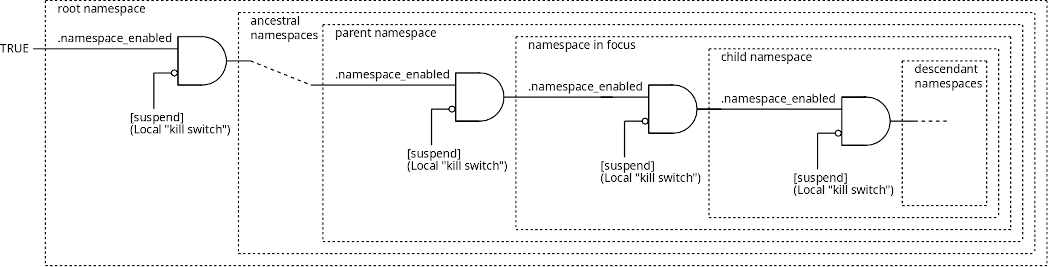
Implemented by switching between symlink to parent namespace's .enabled file and symlink to file containing a value interpreted as FALSE.
There are no circumstances in which the parent namespace's .enabled state will be overriden to TRUE.
-
The transaction is logged automatically and identically in the transaction history/log/journal for both accounts involved, each record comprising:
- Date and time: YYYY-MM-DD hh:mm:ss
- Date and time: UTC
- Time zone
- Payer (if an instance of open money) or initiator of a more general action affecting an account value
- Payee (if an instance of open money)
- Authorization action/event
- Amount/value
- Balance of payer's account (visible only to payer and the currency steward)
- Balance of payee's account (visible only to payee and the currency steward)
- Supplementary notes (optional)
A transaction cannot be altered, cancelled or reversed. It can be negated only by a reverse transaction of equal value.
-
A user who has been a bad actor is marked as to be blocked from re-registering immediately.
This flag indicates that, to the extent possible given available identifying data, this user must be prevented from immediately re-registering in this namespace or in any of its descendants.
-
A user who has been a bad actor is marked as to be blocked permanently from re-registering.
This flag indicates that, to the extent possible given available identifying data, this user must be prevented permanently from re-registering in this namespace or in any of its descendants.
-
Primary email address. Optional. If provided, it can be used for login recovery purposes or to alert the user to an event (as configured) in the user's preferences.
-
The mobile phone number is optional. If provided, it can be used for login recovery purposes or to alert the user to an event (as configured) in the user's preferences.
-
Locally-maintained list of blacklisted MAC addresses.
A background process collects blacklisted MAC addresses from throughout the namespace tree into a globally-accessible list.
-
Locally-maintained list of blacklisted IP addresses.
A background process collects blacklisted IP addresses from throughout the namespace tree into a globally-accessible list.
-
These may be the only sources of identification available and cannot generally be considered absolutely reliable. Therefore a mechanism for appeal and resolution must be available at the human (steward) level.
-
Unless resolved in some satisfactory way, these data sets will in due course be copied to a global blacklist database as well as being preserved at the level of this namespace.
-
Fixed-format notes/log for communication between stewards. Can also be written by automated alert process to inform stewards of activity requiring investigation and/or resolution.
Meta-data applied and read by the underlying mechanisms constrain access as required by configured policy.
-
The creation of this entity (whether a primary identity, a secondary identity, a currency, an account, a namespace or a procedure) has been initiated but is pending authorization.
In most cases the authorization will be needed from a steward (of a namespace or currency) - in most cases given automatically by default - but in the case of a user registration, confirmation will also be required from that user.
-
Upon detection of activity raising cause for concern by a steward or by automated oversight processes, an entity will be suspended (in a manner appropriate to that entity's type). When such a susepension is triggered by the .enabled "kill switch" or another entity's type-specific equivalent, the localized suspension flag will persist after the triggering flag has returned to its permissive state - pending resolution of an investigation.
-
Locally-maintained list of blacklisted email addresses.
A background process collects blacklisted email addresses from throughout the namespace tree into a globally-accessible list.
-
Locally-maintained list of blacklisted phone numbers.
A background process collects blacklisted phone umbers from throughout the namespace tree into a globally-accessible list.
-
An automatically-written log of events relating to this entity, visible only to its stewards.
-
The current (most recent) value (balance) of an account is updated each time a transaction is logged.
The default policy (which can be overriden by the stewards of a currency) is to make this value visible only to:
- The account's holder
- The stewards of the currency
- The stewards of the namespace containing the account
- Upon request, and with the agreement of the other party, a prospective payer - in which case the two account holders are able to each other's account balance.
-
Secondary email address. Optional. If provided, it can be used for login recovery purposes or to alert the user to an event (as configured) in the user's preferences.
-
Cryptographic hash of password.
-
QR codes are used for:
-
Registration by invitation, encoding
- full namespace path to the currency
- the identity issuing the invitation
-
Authorization of payments. In this case a typical usage would be scanning of an account holder's QR code (which might be on a printed card or displayed on a phone) by a merchant's smartphone.
A unique QR code is generated for each primary identity upon registration.
A unique QR code is also generated for each secondary identity (linking internally to a primary identity).
An SVG version of the QR code may generated to improve print quality.
-
Registration by invitation, encoding
-
A date string in YYYYMMDDhhmmssss format.
This file exists only where needed and applies only to time-limited variables.
-
If the variable is subject to decay (or other modification) over time, the function is identified by FIP. The parameters are saved in a separate file (one per line).
This file exists only where needed and applies only to time-limited variables.
-
Each row of the voucher list comprises the following semicolon-separated fields:
- Date/time issued (YYYYMMDDhhmmssss)
- Transaction ID - sequential count unique to each currency
- The currency (FPH)
- The issuer account (FPH)
- Date for use (YYYYMMDD) (if applicable - otherwise empty)
- Expiry date (YYYYMMDD) (if applicable - otherwise empty)
- Time window (hhmm-hhmm) (if applicable - otherwise empty)
- The quantified value (number, count or value) (if applicable - otherwise empty)
- The unquantified value (category) (if applicable - otherwise empty)
- List of places accepting these vouchers (FPH[,FPH[,FPH[,...]]]) (if applicable)
- Pre-defined list of places accepting these vouchers (FPH) (if applicable)
- List of purposes for which these vouchers are accepted (FPH[,FPH[,FPH[,...]]]) (if applicable)
- Pre-defined list of purposes for which these vouchers are accepted (FPH) (if applicable)
When scanned, the voucher is eliminated from the list. This event is logged in the account journals of the voucher issuer, the voucher holder and the currency's steward(s).