NESTS - Named Entities in Simple Tiered Spaces

home | Entity internal structure 1 | Design objectives | Organization of namespaces | Internal implementation of namespaces | Entity internal structure 2

Some design objectives

NB: This is a temporary working document under continual revision as coding progresses. The documents and the initial implementation are co-evolving continually, so expect to find some duplications and occasional inconsistencies (all of which will be removed over time). (See page footer for most recent revision.)


This document describes the structure of NESTS as implemented on any Unix-type filesystem but without reference to any specific programming language.

The structure has been designed to allow NESTS to be implemented using any combination of programming languages.

This is very much a work in progress. It will be extended gradually and it may take some time to eliminate inconsistencies.


Design objectives

  1. Allow users to identify themselves by full namespace path HRNS1, either by primary identity such as
        henry.crun.goons.radio.bbc.uk
    (where crun.goons.radio.bbc.uk is the registry in which the primary identity of that user is registered) or by a secondary identity such as
        henry.crun.goons.org

  2. Map each secondary identity of a user to its primary identity internally using links (FIP 1).

  3. Allow for the naming of named entities using UTF-8 characters, reserving one character ("." by default) for use as the namespace separator.

  4. A user must be able to list its own secondary identities.

  5. A user must be able to list the current state of each of its accounts, whether identified as belonging to its primary identity or to one of its secondary identities.

  6. A user must be able to list the transaction history for each of its accounts, whether identified as belonging to its primary identity or to one of its secondary identities.

  7. The steward 2 of a currency must be able to list the accounts using it, the primary identity of their owners, their current value and their current status.

  8. The steward 2 of a namespace must be able to list the stewards contained within it or any of its descendants along with all entities under their stewardship and the properties of those entities.

  9. It must be simple and straightforward to register in a specific namespace by following an invitation link, either by scanning a QR code or by following a Web link, encoding all the relevant and necessary information such as:

  10. It must also be possible, where appropriate an necessary, using a Web application and a card printer at a participating service provider (sucah as a shop or public library) to register for a validation card on which is printed a QR codes encoding authenticating informtion, i.e.

    Such cards are intended to make the service accessible to users who do not own a smartphone. They can be scanned by merchants (who are more likely to have a smartphone available at a point of sale), and authorized by entry of a password or a PIN. It might als be possible to make use of a device's built-in fingerprint scanner, but the feasibility of thatat remains to be determined.

NB: This is not an exhaustive list. It will be extended and refined.

The namespace conventions used in NESTS are those of open money/measure.

Namespaces and other named entities

OM named entities fall into two main categories:

  1. Non-terminal entities which are open namespaces in that they can contain the names of most other named entities (including namespaces).

    The term namespace (unqualified) refers implicitly to a non-terminal namespace that serves no other purpose than to contain names of named entities.

    All parent/ancestor namespaces fall into this category.

    The identies (both primids and secids) act as private namespaces in that they can contain the names of entities of any type other than namespaces3 to which it is parent, owner (accounts) or steward (currencies).

    A primary identity contains a user's unique identication and authorization data. It exists within a registry (which can be any open, non-terminal namespaces). A primary identity may have (link to) any number of secondary identities.

    A secondary identity linking (by FPH1) to a unique primary identity. This may be placed within any (non-terminal) namespace (with the authorization of, and subject to the rules imposed by, that namespace's stewards).

    Both of these user types are private terminal namespaces the contents of which are accessible only to their owners (the users they identify) and (where different) the stewards of its parent (containing) namespace and its ancestors.

  2. The terminal entities which are:

Notes:
  1. HRNS - Human-Readable Name(space) String
    FIP = Full Internal Path
    FPH = Full Path Hash

    The FIP is simply the full directory path from the root of the entities tree. It has a one-to-one correspondence with the HRNS, the FIP being the directory path from the NESTS data root, each directory being a fixed-length hash of the HRNS names read from right to left.

    Access is simplified (not least because it is both more compact and more consistent) by using the FPH, a fixed-length hash of the HRNS. The FPH is mapped to the HRNS using a fast key:value store (DBM).

    The compactness of the FPH also makes it considerably more suitable for use in URL encoding, SSH commands and REST calls. Although the FIP is faster and more straightforward to process internally, the compactness of the FPH makes it preferable for most purposes.

    Another major advantage of the FPH is that it can be provided as a unique reference ID to any entity, whether an identity, an account, a currency or a namespace.

    In both cases a 128-bit non-cryptographic hash with a very low collision rate (xxHash3_128) is used.
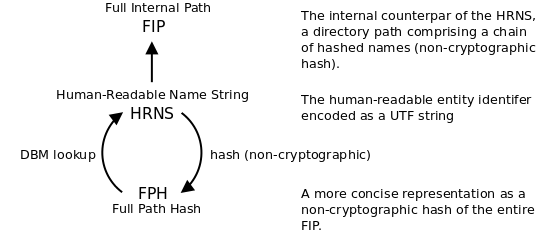
    The fast key:value retrieval system is currently provided by the Unix DBM associative array.

    Obsolescence of FPH to HRNS mappings

    The initial mapping of the FPH to the corresponding HRNS will generally remain unchanged for most of an entity's lifetime. However, in the event of a namespace sub-tree being changed (see note on the pruning and grafting of branches), the original FPH will no longer map on the the FIP and HRNS.

    It is important that none of the FPH of given to the user (those of its identities and accounts in particular) lose their meaning every time the stewards of a namespace decide to move it (and, consequently, all the entities it contains). An FPH should be immortal once created, but there is no reason to place a limit on the number of FPH pointing to a particular FIP (and its uniquely corresponding HRNS). However, the current (most recent) FIP and HRNS can only ever map to the most recently created FPH.

  2. Stewards

    The only distinction between a steward and any other identity lies in the domain of the entities over which it holds stewardship.

    The stewardship of any entity is authorized conditionally by the stewards of the namespace containing/enclosing it. That is the case at every level of recursion from the root to the tips of the branches.

    The means by which stewardship propagates through the levels of recursions, maximizing autonomy throughout within the constraints defined by the foundational level (root) is beyond the scope of this document but will be laid down clearly elsewhere. The structures will be recognizable as those of the VSM.

  3. identities = terminal/private namespaces

    Currently, an identity (whether a primid or a secid) may contain the names of any entities other than namespaces. The identity is therefore both the parent and the sole steward of entities enclosed within it, which makes it both a terminal namespaces and a private namespaces.

    It may be possible to change this to enable namespaces to exist among the descendants of an identity, but it seems less likely that there will be either a possibility or a reason to include identities as as descendants other than children or grandchildren.


Version 0.32 - 2024-09-12 22.20 - Copyright © 2024, 2023, 2022 John Waters


home