NESTS - Named Entities in Simple Tiered Spaces

home | Entity internal structure 1 | Design objectives | Organization of namespaces | Internal implementation of namespaces | Entity internal structure 2

Entity relationships

NB: This is a temporary working document under continual revision as coding progresses. The documents and the initial implementation are co-evolving continually, so expect to find some duplications and occasional inconsistencies (all of which will be removed over time). (See page footer for most recent revision.)

2024-09-12: Because of the urgent need for a functional equivalent of NESTS to support open money requirements only (not the much richer requirements of a full open measure implementation), work has been suspended temporarily to focus on the much simpler SLATE software. In turn, the development of SLATE has led to a number of revisions in the NESTS design.

Table 1: Properties/contents of named entities
entity type containing comprising or including
primary identity identification
  • namespace
  • username 1
authentication
  • private key
  • hash of UI login password 2
  • (biometric data)
relationships
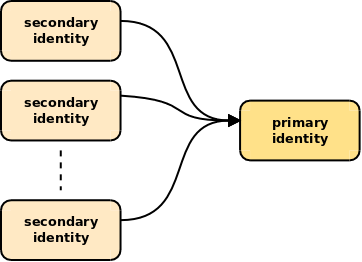
  • list of links (FPH) to secondary identities 3
accounts
  • both primary identities and secondary identities enclose accounts privately within the namespace 4
secondary identity identification
  • link (FPH) to namespace directory of primary identity
accounts
  • both primary identities and secondary identities enclose accounts privately within the namespace 4
account identification
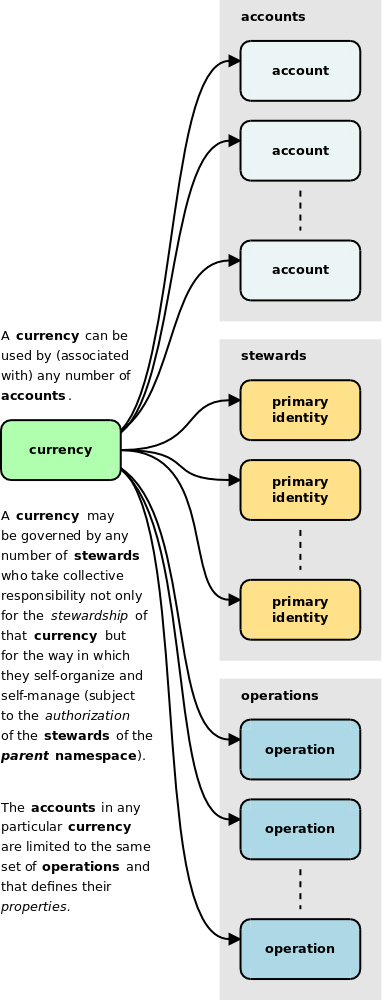
  • link (FPH) to namespace directory of the associated currency
value
  • the persistent record (the type of which is defined by the associated currency.
ownership
  • the ownership of the account is defined by that of the user namespace enclosing it 4
namespace any type of
named entity
  • other namespaces of this type
  • primary identities 6
  • secondary identities
  • currencies
  • accounts
relationships
  • ancestor namespaces (other than parent) are identified by FPH or located by tracing back through directory tree branch
  • parent namespace is represented internally as containing directory
  • child namespace are represented internally as subdirectories
  • descendant namespace (other than children) are identified by FIP
stewards
  • list of links (FPH) to the primary identities of the stewards (governing users of the namespace)
currency identification
  • link (FPH) to directory in which the currency prototype is defined
parameters
  • overriding the defaults associated with the currency prototype
relationships
  • list of links (FPH) to accounts using the currency 5
stewards
  • list of links (FPH) to the primary identities of the stewards (governing users of the currency)
Notes
  1. Identified by full namespace path.

  2. Available if needed by an implementation making direct use of the NESTS package.

  3. When the namespace enclosing a primary identity is moved to any other position in the tree, the link (FPH) associating each secondary identity with it must be updated.

    This also allows listing of the secondary identities associate with a primary identity.

  4. Accounts

  5. When the namespace enclosing a currency is moved to any other position in the tree, the link (FPH) associating each account with it must be updated.

    This also allows listing of the accounts using a currency.

  6. In this case, the namespace serves as a registry.


Property elements/implementation for each entity type

Table 2: Entity types: linkages
entity type linkages contents/properties
links to as number
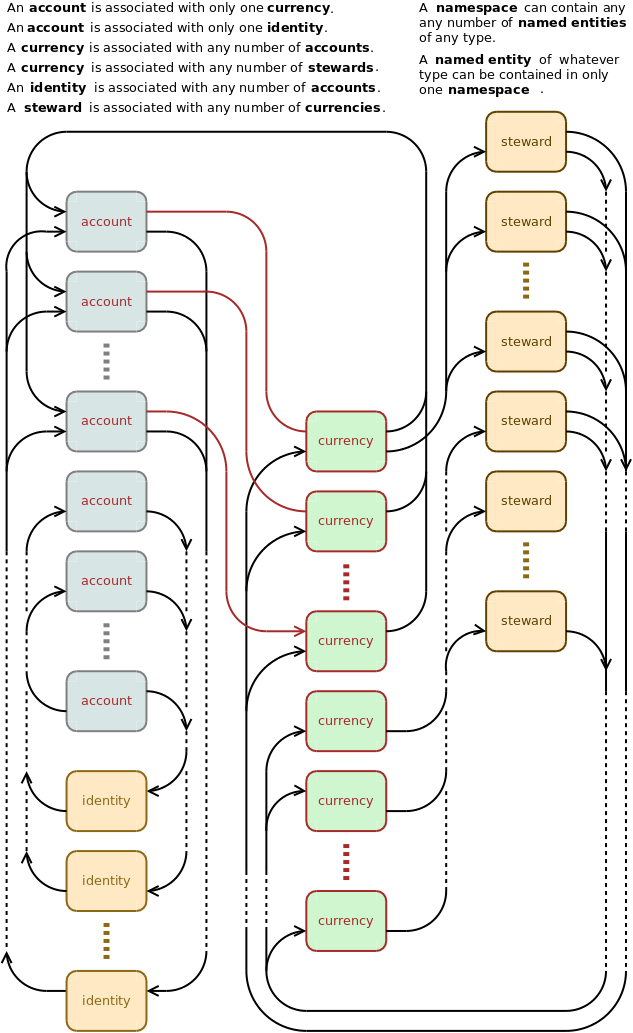
account currency FPH 1 many-to-one 2
  • value
  • status flags
identity FPH 1 many-to-one 2
currency accounts FPH 1 one-to-many 3
  • status flags
stewards FPH 1 one-to-many 3
stewards primary identity FPH 1 one-to-many 3
  • status flags
namespaces FPH 1 one-to-many|zero 4
currencies FPH 1 one-to-many|zero 4
namespace parent namespace directory parent 5 one-to-one 6
  • status flags
ancestor namespace directory parent (chained) 5 one-to-many 6
child namespaces subdirectories one-to-many|zero 4
stewards FPH 1 one-to-many|zero 4
secondary identity primary identity FPH 1 zero|many-to-one 7
  • status flags
namespace containing directory 5 one-to-one 6
accounts containing directory 5 one-to-many|zero 4
primary identity secondary identities FPH 1 one-to-many|zero 4
  • user identification data
  • user authorization data
  • user contact data
  • status flags
namespace containing directory 5 one-to-one 6
accounts containing directory 5 one-to-many|zero 4

Notes for Table 2

  1. FIP = Full Internal Path

    The FIP (reading from left to right) has a one-to-one correspondence with the names in the human-readable path (reading from right to left).

  2. At least one of the first entity type refers (links) to a specific instance of the second entity type.
  3. At least one of the second entity type is associated with (links) to a specific instance of the first entity type.
  4. Zero or more of the second entity type are associated with (links) to a specific instance of the first entity type.
  5. The relationship is defined by the filesystem parent-child relationship (relative) rather than by FIP (absolute location).
  6. A namespace can have only one parent but can have any number of ancestors.
  7. Zero or more of the first entity type are associated with (links) to a specific instance of the second entity type.


Version 0.31 - 2024-09-12 22.00 - Copyright © 2024, 2023, 2022 John Waters


home