Effort is currently being focussed upon the completion of the following components:
The NESTS core - a collection of Python3 functions implementing a very simple ad hoctree-structured DBMS built upon an Unix-type filesystem.
These include functions for:
A collection of Python3 functions implementing a CLI (Command Line Interface) of sufficient richness to support immediate testing, demonstration and experimentation.
Initially, this CLI will comprise a set of operations sufficient for all open money requirements. In due course it will be extended to include a richer set of functions to support open measures requirements.
This interface will not be suitable for most users' needs, but it is by far the easiest to implement, test and extend. It also provides a very useful scriptable API accessible via SSH.
A collection of simple shell scripts to execute the CLI commands over SSH.
These shell scripts are created per user and each contains a unique authentication code.
Such shell scripts are themselves callable by other scripts, using a diversity of languages, allowing the rapid development of larger-scale structures.
A simple Web interface implemented using Flask.
For the majority of users, this will provide a more accessible and appealing interface.
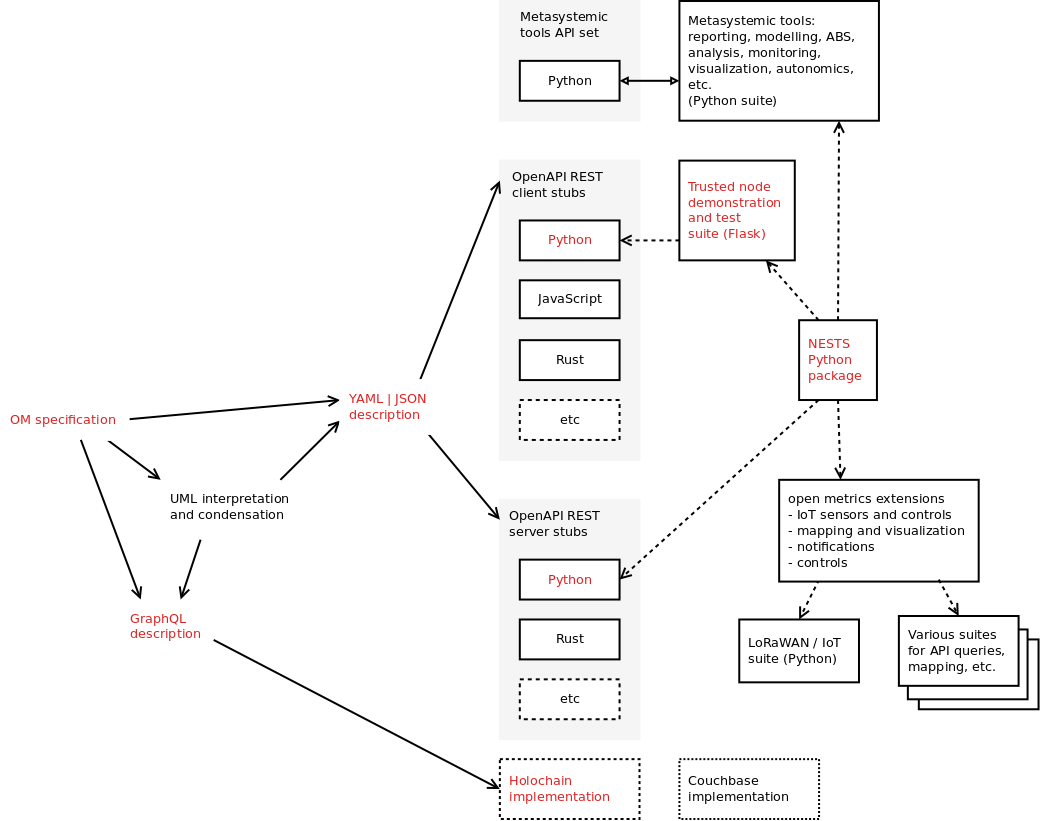
An OpenAPI-generated REST API (implemented using Flask or Falcon) to provide an alternative entry point where required.
Currently this has a lower priority given that most shorter-term requirements can be met using the provisions above.
Complete OpenAPI-generated client libraries (Python and Rust initially).
Develop a richer collection of reference clients.
Design and develop simulation/modelling/visualization suite (ABS).
Develop user feedback systems.
Add further OpenAPI-generated client libraries (JavaScript and PHP initially?).
| layer | API | abstraction functions | significant extensions | constraints |
| open money | open money APIs | open money rules |
The APIs at this level constrain behaviour to the open money rules. |
|
| open metrics | open metrics APIs | open metrics rules |
The APIs at this level constrain behaviour to the open metrics rules. |
|
|
extended open metrics |
extended open metrics APIs |
open metrics extended rules |
Provides support for compound data types (vectors, matrices and n-tuples), time series and executable objects (both direct/native and indirect/referenced). |
|
|
ledger/nesting management |
ledger management |
recursively nestable ledgers management |
Minimal constraints. | |
|
These layers represent different sets/ranges of capabilities, each accessed via its own collection of APIs. |
Each layer may provide a set of APIs accessing its abstraction functions, both remotely (REST or GraphQL) and locally (in some cases simply by exposing the abstraction function set as native package/library or by providing a set of bindings from one language to another). |
|||
Because the recursive namespace structure naturally mirrors the structure of a Unix-like filesystem, that is being used as the basis of this implementation, providing a quicker route to development of
The recursively-nested, holonic structure of the OM suite reflects the structure of the Viable System Model, so a suite of tools will be developed over time to support its application.
Version 0.2a - 2022-09-25 21:10 - Copyright © 2022, 2021 John Waters