A very brief introduction to vector currency support in NESTS
The usage of the term vector currency has gradually expanded over
the years as the potential applications have grown in number. The term
vector is no longer adequate, but the term tensor no longer
seems to add enough either. Perhaps the term compound should be
preferred, but the abbreviation CC is already overused (sometimes)
leading to unhelpful conflation, so for time being (not least for consistency
with usage elsewhere on this site) the term "vector" will remain in
use.
As ever, it is important not to conflate the meaning of currency in
this context with that of money. The former is very general,
referring to an variable with an application to motivate action. The latter
(not least to be consistent with its use ine the context of open
money) refers to a unit of account representing that a value
has been agreed and recorded by both parties involved in a transaction,
signifying an end to it. Such money is absolutely not a commodity
and enforceable expectation is not implied in such a transaction.
Some applications of compound currency types in NESTS
A few potential applications include:
-
Support for multi-component payments.
-
Information-preserving impact measures (open measure
[1]) to enable and encourage better
informed decision-making at any level or scale. The richness of the
information set provided at the point of deliberation or evaluation must be
matched to both the needs and the capacity of the decision-maker, so the
information set must not be attenuated prematurely. At the same time, it
will be appropriate at various points to spawn aggregated/attenuated
impact vectors to support ramification without consuming excessive
storage capacity.
-
Reputational measures sufficient to mitigate the familiar and dangerous
problems associated simple scalar values.
-
Aggregation, attenuation and weighting of vector measures,
allowing the generation of diverse and information-rich sets appropriate to
different decision-makers' needs.
-
Processing of time series data to produced algedonic signals.
Compound currency structures in NESTS
NESTS supports a number of compound structures (vectors, matrices, n-tuples)
and potentially higher-dimensional tensors.
In this section, two prototype vector currency categories are
considered:
-
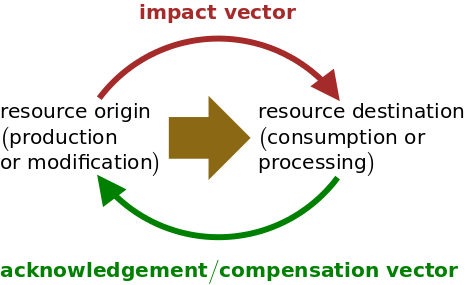
impact vectors
-
acknowledgement vectors
Impact vectors
Applications of the impact vector type include (but are not limited
to) recording of:
-
Environmental and ecological impacts (resource depletion, environmental
degradation, ecosystem disruption, biodiversity loss, etc.) - whether
measured directly or assessed by a trusted source.
-
Social impacts (effects on health, access to essential resources, effects
on social conditions, etc.) - whether measured directly, inferred from
trusted models or assessed by a trusted source.
-
Acknowledgement records - including a history of value assessments
(multi-dimensional) and payments.
-
Reputational measures (multi-dimensional) - including confidence measures
on information sources.
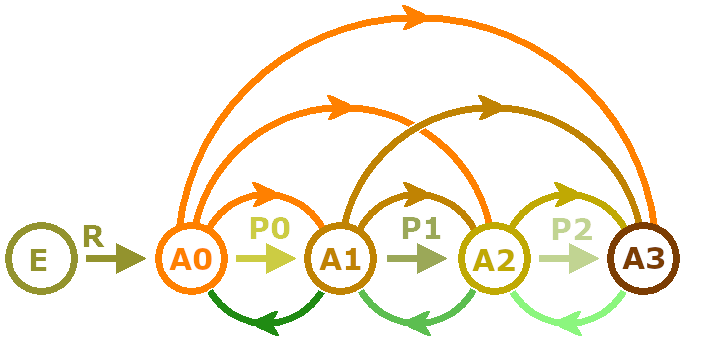
The following simple example illustrates a few basic points:
-
➡
a natural resource not yet extracted from its
environment/source
-
➡
a resource extracted/processed by
agent A0
-
➡
a resource processed by agent A1
-
➡
a resource processed by agent A2
-
⟶
an impact vector shared by agent A0
from step 0
-
⟶
an impact vector shared by agent A1
from step 1 (inheriting and extending that from step 0)
-
⟶
an impact vector shared by agent A2
from step 2 (inheriting and extending those from steps 0 and 1)
-
⟵
an acknowledgement vector (e.g. payment from A1 to
AO)
-
⟵
an acknowledgement vector (e.g. payment from A2 to
A1)
-
⟵
an acknowledgement vector (e.g. payment from A3 to
A2)
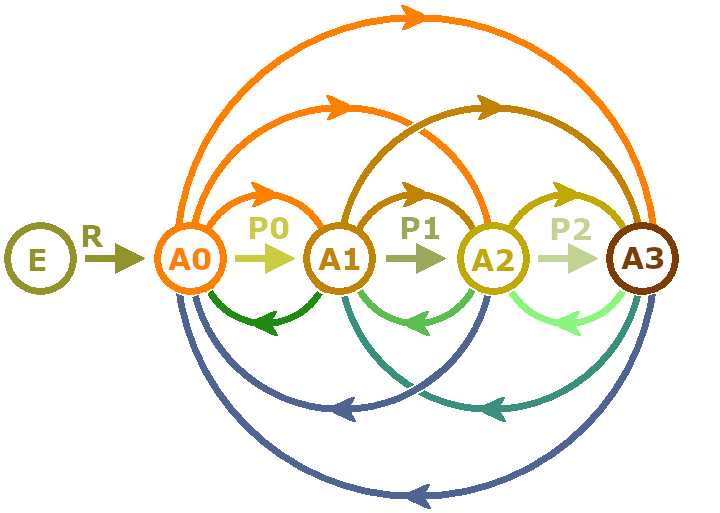
Additional feedback paths can be added to update the values established
earlier in the sequence, e.g.:
In the event of such a retrospective adjustment, the entire sequence
following would have to be adjusted. There is not yet an obvious reason
either to allow such an action by default or to encourage it. This has
been added here mainly to illustrate what is practicable.
Where such a retrospective adjustment had been made, its details would be
recorded in the journals of each of the entities affected.
The illustration above barely scratches the surface of what might become
possible as the feedback and feedforward paths are extended and refined.
For example, the following additional paths and flows might be added:
-
Guidance (attractors and deflectors) to assist consumers in making
purchasing decisions.
-
Richly informative data sets for policymakers and political decision
makers.
-
Richly informative data sets for autonomic technology (e.g. in
semi-automated food-production environments).
-
-
-
-
"Tithing" payments passed back to those impacted in order to provide
compensation for negative impacts on their environment and livelihoods.
A minimal structure
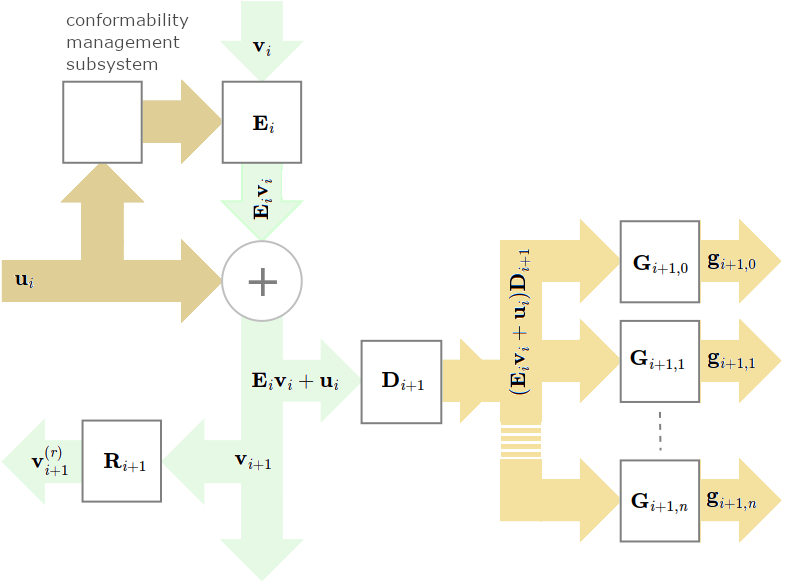
A minimal structure on which to build such an approach will now be described.
The essential components here are:
-
An update vector - adding additional data to to sequence.
-
An expansion matrix - increasing the number of elements in
the impact vector where necessary to accommodate the update vector.
-
A ramification matrix - mapping the current path "node" to
the start of a new branch.
-
A decision matrix - mapping the impact vector to a set of
guidance vectors.
-
A guidance vector - a collection of scalar indicators to
meet the needs of a particular category of user.
-
A ramified impact vector - a new chain of impact vectors
is spawned.
\[
\begin{align}
&{\textbf{v}}_i \in\mathbb{R}^n &i \ge 0 &\hphantom{\text{________}}
\text{impact vector} \\
&{\textbf{v}}_{i+1} \in\mathbb{R}^n &i \ge 0 &\hphantom{\text{________}}
\text{impact vector} \\
&{\textbf{u}}_i \in\mathbb{R}^m &i \ge 0 &\hphantom{\text{________}}
\text{update vector} \\
&{\textbf{E}}_i &i \ge 1 &\hphantom{\text{________}}
\text{expansion matrix} \\
&{\textbf{E}}_i{\textbf{v}}_i \in\mathbb{R}^m &i \ge 1 \\
&{\textbf{R}}_{i+1} \in\mathbb{R}^m &i \ge 1 &\hphantom{\text{________}}
\text{ramification matrix} \\
&{\textbf{D}}_{i+1} \in\mathbb{R}^m &i \ge 0 &\hphantom{\text{________}}
\text{decision matrix} \\
&{\textbf{g}}_{i+1,p} \in\mathbb{R}^m &i \ge 0 &\hphantom{\text{________}}
\text{guidance vector} \\
&{\textbf{v}^{(r)}_{i+1}} \in\mathbb{R}^m &i \ge 0 &\hphantom{\text{________}}
\text{ramified impact vector} \\
\end{align}
\]
where
\[
\begin{align}
m &\ge n \ge 1 \\
{\textbf{v}_{i+1}} &= ({\textbf{E}_i} {\textbf{v}_i} + {\textbf{u}_i}) \\
{\textbf{v}_{m}} &= \sum_{i = 0}^{m-1} {\textbf{E}_i} {\textbf{v}_i} +
{\textbf{u}_i}
\end{align}
\]
The dimensions of the matrices are increased wherever necessary to
accommodate the additional mappings (and obviously also to ensure
conformability). Therefore, at each step the number of elements in the
impact vector may grow, although the data subset selected
for aggregation and attenuation may well not do so.
Acknowledgement vectors
Examples of acknowledgement vectors include:
-
compound payments (for high-variety money sets)
-
reputational vectors (information rich)
-
distributed algedonic alerts (probability vectors)
-
reward trigger vectors (event activation)
Practical implementation
In order to simplify implementation, impact vectors,
acknowledgement vectors and compensation
vectors are all stored as a JSON structure in which the keys are
necessarily unique and the values are written to an ordered array mapped by
alphabetical order of key. The JSON structure therefore serves both to enable
the mapping (and its inverse) and to store the values themselves when not
being operated upon.
The ordered array (however constructed - i.e. using whatever language this
component is written in) makes it straightforward to perform any required
matrix operations in a very conventional way.
Wherever the number of elements in the impact vector increases, the position
of the columns and rows in the mapping matrix must be adjusted appropriately
within the JSON structure.
Notes: