The starting point
There are two three basic approaches to the implementation of an open money1 infrastructure:
- centralization - everything in a single node 2;
- clustering - an arbitrarily large collection of nodes, each able to host an arbitrary number of namespace trees and maintaining an arbitrary number of connections to other such nodes; or
- distribution - a single, globally-connected network within which any number of other networks may exist in effective isolation from each other.
Of these, the first must be rejected for reasons of both scalability and robustness. The second and third are both realistic options, but the second is much simpler to implement in the shorter term. They all present essentially the same set of challenges with reagrd to stewardship (governance).
Accessibility and identification of named entities
One of the fundamental requirements is that the system must be of use to (and manageable by) anyone3 regardless of language or alphabet4. Therefore the human-readable names (of whatever entity) should be encoded using the most appropriate alphabet4 for use locally.
For this reason, the entity namespace paths are distinct from the URLs of the nodes2.
This separation provides an additional advantage: an entity (most often an account or an identity) may be accessed via more than one node (something very useful in the case of a node being temporarily inaccessible) because replication across nodes can be made consistent very easily (and quite quickly) assuming accurate time-stamping.
Identification of root namespaces
Every namespace tree has a root namespace uniquely identifying any entity in a sub-tree below it, but does the name of that namespace have to be unique across all nodes?
Every combination of node URL and namespace path must be unique, but that leaves open two possibilities:
- either the name of the root namespace is unique across all nodes
- or the name of a root namespace in a particular set of nodes may be used in any number of disjoint sets of nodes to refer to completely distinct root namespaces.
The first of these two options is both impractical and unacceptably authoritarian. Who can decide ultimately on the right to a unique name? (That happens, of course, with the global domain registration system - but that is very expensive, very messy and presents an unacceptable governance burden - one of which we are quite happy to take advantage in the unique identification of node URLs but one which we do need to attempt to replicate in the namespace structures).
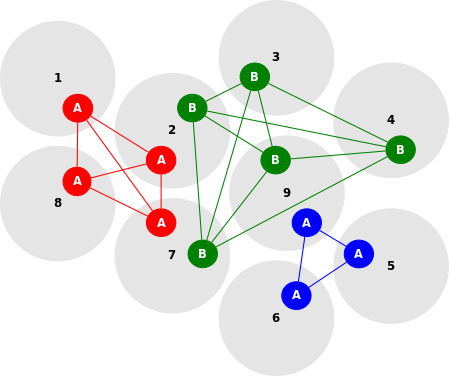
The very simple solution arises from the ability of any collective of stewards to decide with which other networks they associate, and how. Wherever a namespace's name exists within more than one node within the same cluster (i.e. sharing the same collective of stewards) then these will be replicates accesible from anywhere within that cluster. These, however, have no association with any namespace that happens to have the same name within a different cluster.
In the simple example to the right, a root namespace named A is replicated across (and therefore accessible through) four nodes2 (1, 2, 7 and 8). A completely unrelated root namespace is coincidentally also named A. In this example it is replicated across a different set of nodes (5, 6 and 9). The only restriction is that they share no nodes in common. In this example, a third root namespace named B is replicated across nodes (2, 3, 4, 7 and 9), sharing at least one node with both A and B.
Nevertheless, it would probably be wise practice for the stewards of any cluster to try to find a way to minimize the risk of causing possible confusion to users, and the voluntary avoidance of root namespace duplication would help greatly. However, such a thing would be impossible to enforce without expensive and authoritarian governance structures - which fortunately are not needed.
Of course, any user needs to know which nodes may be used to access their own entities so, for their convenience, a list of replicant nodes can be provided on request at any time.
Isolation of bad actors
Given that two root namespaces of the same name are distinguished not just by node URL (each is identified by a set of node URL), in an ideal world of undending consensus, the first option above (name of a root namespaces being unique across all nodes) might be more appealing simply as a means to avoid confusion.
Unfortunately we do not live in a world of undending consensus. There may be many reasons why we might need to accommodate (and facilitate) the duplication of root namespace's names, but one very obvious example is that of a geographical root namespace being created and claimed early by a stewardship of bad actors5 whose intention is to prevent the development of a commons-orientated, co-operative support structure within their own locality. Fortunately, that is not a problem where another geographical root namespace of the same name can be created and claimed by a stewardship of good actors5. It is the latter which will attract other good actors5.
This opens the possibility of co-operative federations of stewardships recognized mutually as good actors building and maintaining lists of bad nodes (those under the stewardship of bad actors) and good nodes (those under the stewardship of good actors). Without an overarching governance system (impractical and undesirable for reasons already given) there is no way to prevent the formation of networks of bad actors, but they can be identified and isolated from the networks of good actors.
Stewardship: nodes and root namespaces
In the case where the name appearing in a set of nodes identifies the same (replicated) root namespace, its stewards6 must have the necessary privileges on all those nodes.
In general, the stewardship of a node6 is distinct from the stewardship of a root namespace. However, for the sake of clarity and simplicity, there is a distinct advantage where the stewards of a particular root namespace also hold a position of sufficient inluence within the stewardship over the nodes across which it is hosted.
That is not an absolute requirement, however. The essential requirement is realizable co-operation between the nodes across which any particular root namespace is replicated.
Although the immediate focus has been upon ensuring that nodes can be implemented very conventionally using any host, whether "virtual" or "real", running a Unix-like operating system, the concept of a node can be generalized to any enclosure to which a stewardship can be applied. If such can be implemented on a wholly distributed system, that may provide a better solution. That remains to be decided.